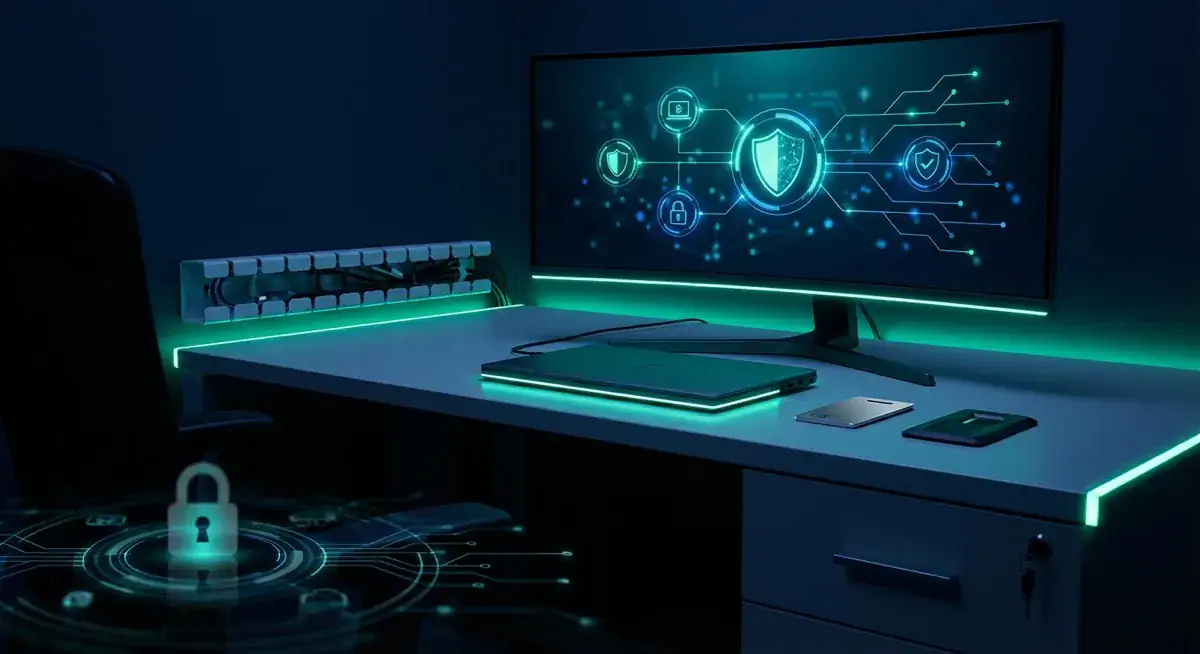
Clean Desk Policy - order for more IT security!
By the end of the day, everything has to be off the table - the Clean Desk Policy ensures more order, but also more IT security? In some employment contracts, i...
 Chris Wojzechowski Geschäftsführender Gesellschafter
 TL;DR
A Clean Desk Policy requires employees to clear their desks of documents and devices at the end of each day, reducing the risk of unauthorized access to sensitive information by cleaning staff, visitors, or other employees. Beyond security, it reduces document search time and supports GDPR compliance through proper paper shredding (particle cut required for highly sensitive documents). The SANS Institute provides a free English-language policy template. In flexible workplace environments, clearing up is mandatory regardless of assigned seating.
Table of Contents (2 sections)
By the end of the day, everything has to be off the table - the Clean Desk Policy ensures more order, but also more IT security? In some employment contracts, it is already firmly written into the contract: The obligation to keep the desk clean. Often this includes paper, but occasionally also personal matters such as a picture. Paper is patient - the saying says it all. Because it does not harm the paper. But sensitive information is then visible to anyone who has access to the desk.
Sensitive documents and personal data should not be visible and accessible!
There are indeed many reasons for a clean desk policy. One is that the largest business risk worldwide is cyber risk. If everything is sorted, filed, and put away directly, there's less flying around. This results in less time spent searching for documents. But the constant clearing up and putting away has other advantages. Unauthorised persons, such as cleaning staff, cannot gain access to the documents. In the context of IT security, much of the Clean Desk Policy aims to ensure that information is not carelessly made available to unauthorized third parties. Criminals only need a very short time to exchange hardware. It does not have to be the often used mouse or keyboard. The replaced, but manipulated iPhone cable is also sufficient. But also other persons with access rights do not have to be served the valuable information on the tablet. This does not mean post-its with passwords. https://www.youtube.com/watch?v=NVWn4hETb8Q
There are controls to eliminate the chaos.
In times of flexible workplaces, tidying up the workplace is obligatory anyway. But even where there is a fixed seating arrangement, the Clean Desk Policy can be effective. And if you take the instructions as seriously as a no stopping sign, you may be surprised if there are pictures of the desk before-after. In various auditing companies, documents and technology left lying around are collected in the evening. Anyone wanting to get back to the technology had to report to the service department. If you have to deal with the Clean Desk Policy, you should first clean out your desk thoroughly. An english language template is provided by the SANS Institute. Information such as QR-Codes can also be sensitive. Documents that are no longer needed should be shredded in consultation with the GDPR. At this point it should be noted that there have been minimum requirements for paper shredders since the GDPR came into force. fines have been generously imposed in the meantime. Then it goes to the system. At this point there should be uniform regulations. Does the company bicycle land under F or under L as in leasing?
Monthly Threat Report
Chris Wojzechowski bewertet einmal im Monat die aktuelle Bedrohungslage aus Sicht eines Informationssicherheitsexperten. Sein 30-köpfiges Team ist näher an realen Cyberbedrohungen dran als kaum jemand sonst - mit konkreten Handlungsempfehlungen, die Sie am nächsten Morgen umsetzen können.
Bestseller-Autor (Wiley-VCH) · M.Sc. Internet-Sicherheit · Bekannt aus Handelsblatt & WamS
Zuletzt behandelt
1x im Monat · Kein Spam · Jederzeit abbestellbar · Datenschutz
Next Step
Our certified security experts will advise you on the topics covered in this article — free and without obligation.
Free · 30 minutes · No obligation

